









The contributions that women have made to space travel have been greatly diminished throughout the telling of history. Still, as of June 2020, women made up less than twelve percent of the astronauts who have been to space. Despite this, women have built the capacity of space travel from the ground up and continue to make inspirational efforts and innovative history every single day.
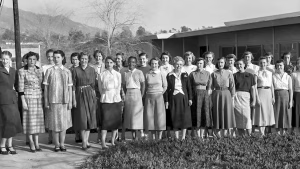
In the early days of space exploration, women served as “human computers,” mathematicians who processed all relevant data by hand. These women performed calculations for launch windows, trajectories, and fuel consumption in the early years of NASA’s space missions. The first “human computer” was named Barbara Canright. She calculated anything from how many rockets were needed to make a plane airborne to what kind of rocket propellants were needed to propel a spacecraft. Each calculation would take her over a full week to complete, filling up six to eight notebooks with formulas and data. Canright was the first “human computer,” but she was nowhere near the last of these important women in NASA history.
In 1953, Janez Lawson became the first African American woman to work in a technical position at NASA’s Jet Propulsion Laboratory (JPL). Dorothy Vaughan, an African American woman who worked in the “colored” computers section at the Langley Research Center in Virginia, became the first African American manager at the firm. She immediately began to hire women. Soon enough, a team of African American women formed in NASA’s Langley workforce.
Katherine Johnson was one of multiple women to join this team at the Langley Research Center. Johnson was a physicist, space scientist and mathematician, and she provided calculations that provided for Alan Shepherd’s first flight to space, John Glenn’s orbit of the earth, and the trajectory for the Apollo 11’s moon landing. To this day, Sue Finley, one of the first “human computers” still works at NASA’s JPL, currently dedicate to NASA’s Jupiter mission.
Dr. Patricia Cowings was the first American woman to receive astronaut training in 1971. While she did not go to space, Cowings created a program that greatly improved the quality of life for astronauts during their travels. Cowings developed a patented training program that teaches astronauts to control factors that contribute to motion/space sickness.
In 1963, Russian engineer and former Soviet cosmonaut Valentina Tereshkova became the first woman in space. Once a textile factory worker, Tereshkova flew a solo mission on the Vostok 6 spacecraft, orbiting earth forty-eight times and spending three full days in space. In 1982, Svetlana Savitskaya became the second woman in space, boarding Russia’s Soyuz T-7. In 1984, Savitskaya boarded the Soyuz T-12 and became the first woman to go to space twice, and the first woman to perform a “spacewalk”— an activity outside of an aircraft while in space.
Sally Ride was an American physicist and astronaut, as well as the first American woman (and third woman overall) to fly to space. She was the youngest American astronaut to explore space. She was selected to be a mission specialist with NASA’s Astronaut Group 8, the first American group to allow women. She helped develop the Space Shuttle’s robotic arm, and served as the capsule communicator for the second and third Space Shuttle flights. In 1983, Ride flew to space on the Challenger Space Shuttle. Her second flight also took place on the Challenger in 1984. She was the only person to serve on both investigative committees in charge of the losses of the Challenger and Columbia space shuttles. Discovered only after her death, Sally Ride was also the first astronaut known to have been a member of the LGBTQ community.
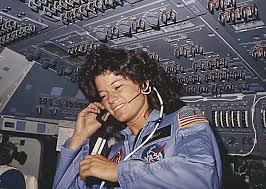
Peggy Whitson, the thirteenth Chief of the Astronaut Office, holds the record of having accumulated a total of 695 days in space, more than any other woman or American in general. In 2017, she became the first woman to command the International Space Station twice. She spent 289 days in space during a singular flight, the record for women until it was broken in 2020 by Christina Koch. Whitson holds the record for performing the most spacewalks out of all women (10), as well as being the oldest to do so.
In 1986, NASA held a “teachers in space” program. Christa McAuliffe, a female teacher from New Hampshire, was chosen from over eleven thousand applicants to become the first teacher to fly into space. She planned to teach lessons about and perform experiments within the Challenger Space Shuttle. On the same day that the Challenger took off, and not even two minutes after the initial launch, the shuttle broke apart. All of the astronauts on board were killed. After her death, McAuliffe received the Congressional Space Medal of Honor. To this day, McAuliffe’s tragic circumstances and bravery are remembered by Americans all throughout the country.
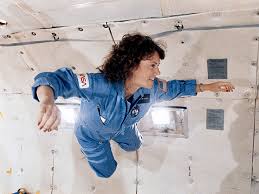
Also aboard the Challenger Space Shuttle on that fateful day was Judith Resnik, an American electrical engineer and the fourth woman to fly in space. Resnik was also a part of the NASA Astronaut Group 8, and her first flight mission took place in 1984. Resnik was another extremely influential loss in the history of space travel, and her memory carries on to this day.
Kalpana Chawla was the first woman of Indian origin to participate in space travel. In 1997, Chawla flew on the Space Shuttle Columbia as a mission specialist. Her second mission took place in 2003, on the final flight of the Columbia. The Columbia’s left wing was damaged by debris during the launch of the spacecraft, and during the re-entrance into Earth’s atmosphere nearing the end of the mission, Columbia’s heat shield was penetrated, leading to the complete disintegration of the shuttle. All seven astronauts, including Chawla, lost their lives during the disaster. On the same mission was Laurel Clark, a mission specialist and medical doctor who was experiencing her first space flight.
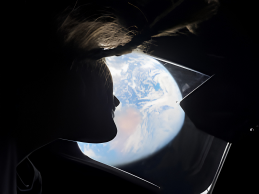
As of 2026, over sixty-five women have flown in space, representing nearly ten percent of total astronauts. On April 1st, 2026, four astronauts were sent to space on the Artemis II for a ten-day lunar flyby. The flight took the record for the farthest distance humans have travelled from Earth, bringing these four astronauts into the public spotlight. Christina Koch became an astronaut in 2013, beat the record of the longest time a woman spent in space in 2020, and took off on the famed Artemis II launch at the age of forty-seven years old. On the Artemis II, Koch also became the first woman to travel beyond low Earth orbit and journey around the moon. On April fifth, Koch made a post to social media with the caption “First braids to leave Earth orbit. (unconfirmed).” The photograph pictured Koch with her hair braided in front of a window with a clear view of the earth. This photograph experienced extreme social media attention, and brought up many emotions and much inspiration to women online around the world.
Women have revolutionized space travel for decades, and the importance of understanding the history of women’s involvement in the science is often understated. As the topic of space travel continues to be explored, it is valuable to consider the women who produced many important discoveries in the past, as well as to look upon those who will make more of these important contributions in the future.